

Secure Bancard is a US payment processor that runs underwriting, onboarding, risk, billing, and merchant funding in-house. At roughly 15 million transactions a year, penny-level accuracy and fixed morning windows are the floor, not a stretch goal.
Intronsoft had already spent more than four years embedded on that merchant lifecycle platform. When growth pressure required another leap, the same partnership executed a focused scale rebuild instead of starting cold.
This case study covers that rebuild. How the ISO processing platform was built is covered in Part 1.
Partnership context
Over four years, a five-person Intronsoft team worked alongside Secure Bancard's staff on a rule-driven platform: fees, risk, underwriting, daily processing, ACH, ISO-on-platform, and Merchant Portal.
That surface is the subject of the companion platform case study. This page focuses on the architecture migration that gave the same domain 10× headroom without rewriting the business.
The challenge
Accuracy, SLA, and cloud cost collided as volume rose. Fixed processing windows and penny-level precision could not bend, and spend could not keep climbing on the old stack.
Morning settlement, authorization, and dispute files still had to clear a full Daily Ledger cycle, including dynamic risk review, within 15 minutes as merchant count grew.
Secure Bancard needed 10× capacity without another full re-architecture cycle, and without cloud spend growing faster than revenue.
Container-first architecture: the solution
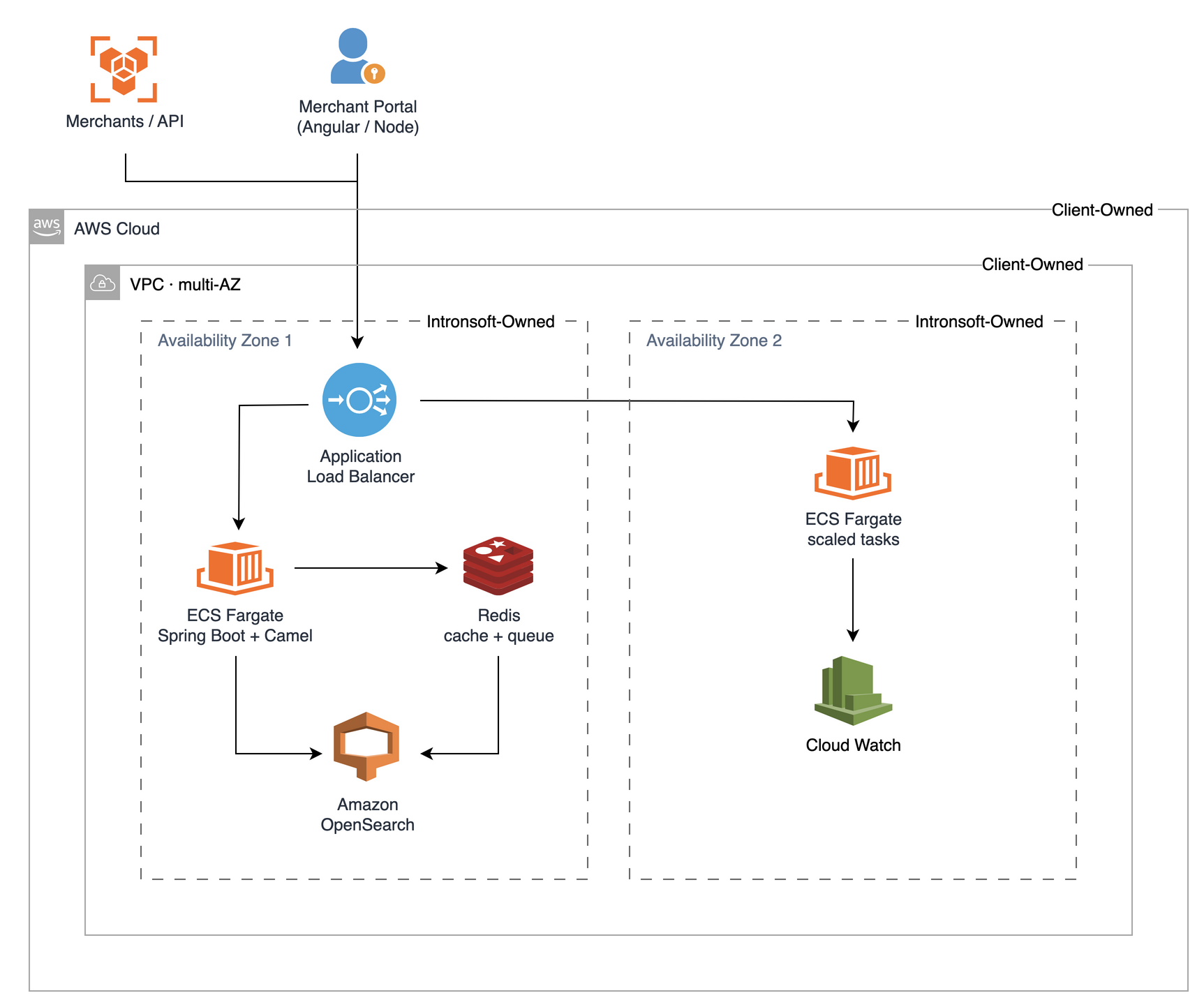
The bet was a container-first back-end: Spring Boot and Apache Camel on AWS ECS Fargate, one Redis layer for cache and queue, Amazon OpenSearch for processed transactions, and multi-AZ operations with automated deploy and scale from day one.
Redis held hot lookups, settings, and pipeline messages in one layer instead of two cloud bills. Business logic continued to run across batched data in the Camel path so penny-level handling stayed intact at higher throughput. Front-end delivery stayed on Angular and Node.js against the same APIs.
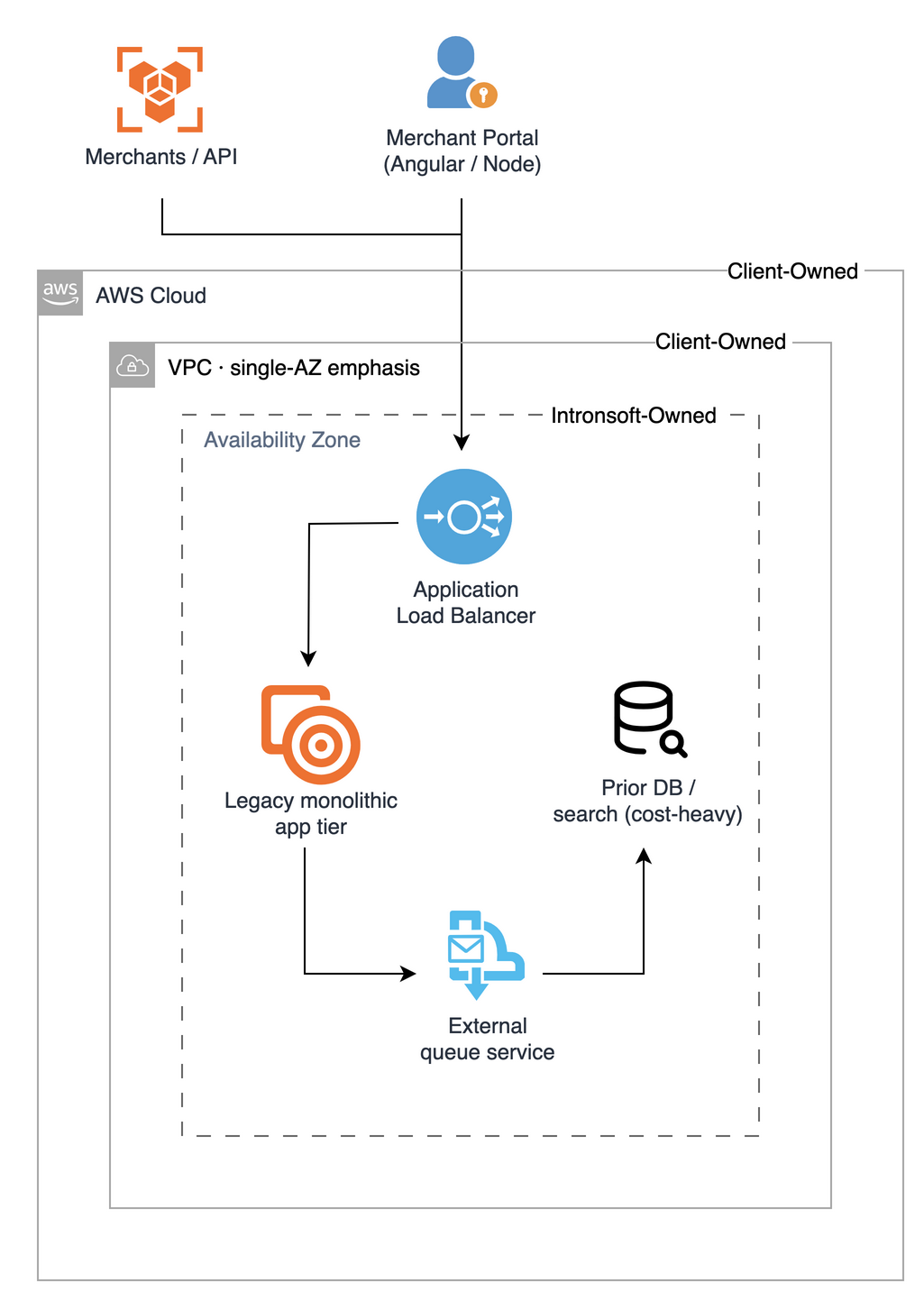
Implementation journey
Intronsoft assembled an eight-person squad: a system architect, two back-end developers, two front-end developers, a DevOps engineer, a QA engineer, and a project manager.
Engineers embedded alongside Secure Bancard's team. Secure Bancard retained payment workflows and merchant operations. Intronsoft owned the rebuilt back-end, Redis and OpenSearch integration, and DevOps automation.
Delivery protected accuracy at every stage, load-tested toward 10× targets, monitored spend against the $2,000 per month goal, and baked automated deploy and scale into the cutover so the next volume jump would not need another migration.
Business impact
Merchants and operations kept morning processing windows intact at volumes the prior stack could not sustain.
Finance gained predictable cloud economics on infrastructure sized for 10× growth, with monthly spend held under $2,000. Engineering gained a simpler day-two model: one Redis layer, containerized deploys, and automated scaling as merchant volume rises.
Results
Within three months, the rebuilt platform demonstrated 2 million transactions processed end-to-end in 16 minutes.
Transaction volume headroom reached 10× on the AWS-native stack. Monthly cloud spend stayed under $2,000 on that footprint. Penny-level accuracy held across the migration, and morning settlement, auth, and dispute files clear the daily cycle inside the 15-minute SLA on production.
Looking ahead
The rebuild positions Secure Bancard to grow transaction volume without repeating the migration. Automated deploy and scale patterns absorb merchant growth without a second architecture cycle.
Part 1 built the merchant lifecycle platform over 4+ years. Part 2 gave that platform 10× headroom on AWS-native infrastructure.
